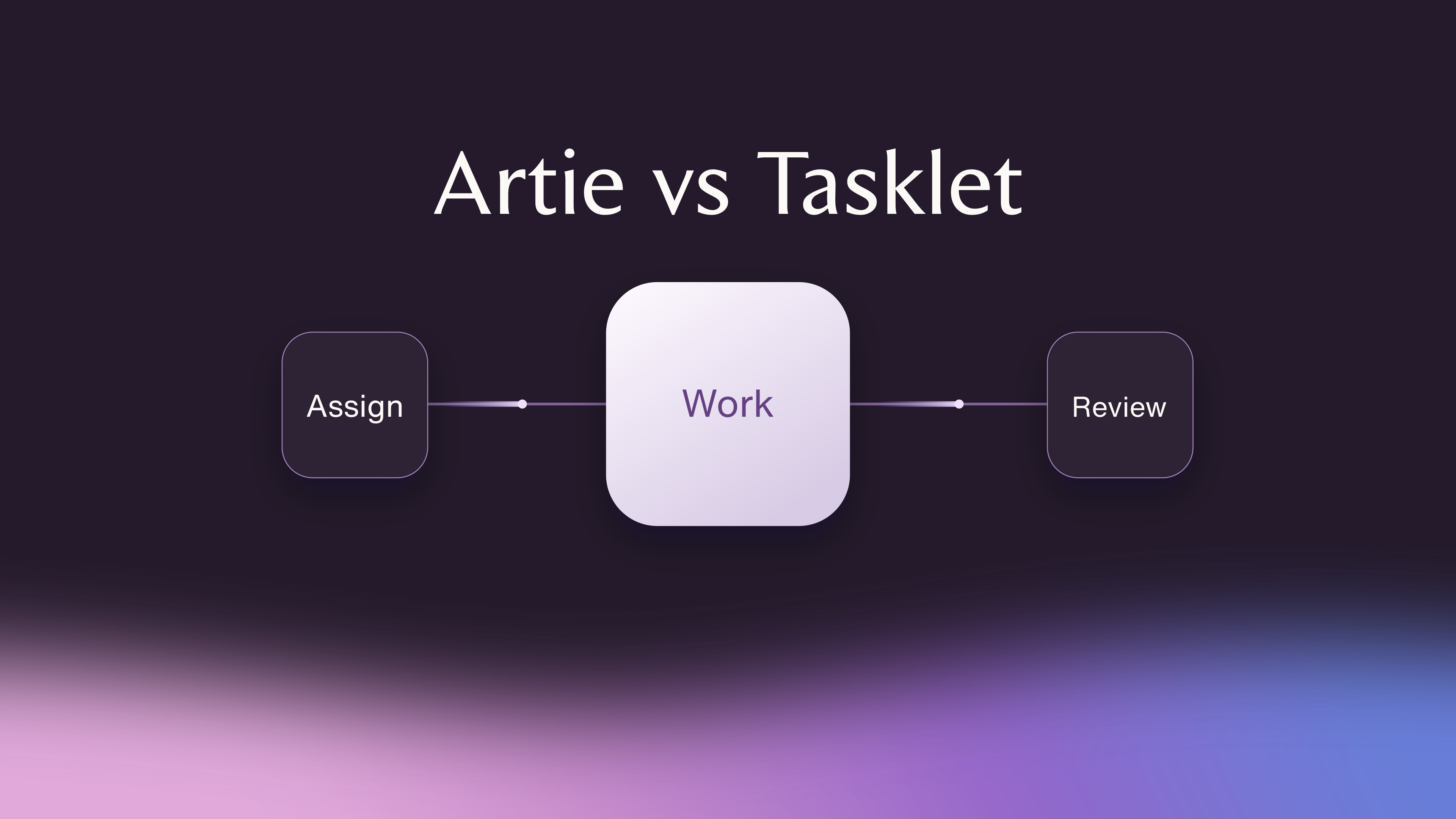
Artie and Tasklet both carry out work across connected tools, retain context and continue assignments between conversations. The useful comparison is the work your team will receive and where colleagues will review it.
Choose Artie for engineering and editorial work that needs follow-through: pull-request findings resolved with the author, reported bugs returned with a regression test and proposed fix, or content developed through your team's feedback and approval. Gilfoyle and Peggy cover those jobs as concrete working practices. Tasklet combines autonomous agents with reusable Skills, shared resources and interactive apps, giving teams another substantial route to the same kinds of business work.
Compare the work, context and review
Buyer decision | Artie | Tasklet |
|---|---|---|
Engineering work | Selected PR review, bug reproduction and regression tests, changes proposed in GitHub, production-alert follow-up | Agents use connected tools, run code in cloud sandboxes and respond to schedules or app events, including GitHub |
Content work | Peggy plans the calendar, develops drafts, coordinates feedback and publishes approved work | Agents use instructions, prebuilt or custom Skills, files and memory to produce content and run recurring work |
Team context | Gilfoyle works in selected repositories and connected logs. Peggy uses your source material and editorial standards | Threads draw on the same agent's memory and resources. Shared Drives distribute files and Skills across agents |
Reviewing the result | Engineers review proposed changes. The content lead sets Peggy's editorial review process | Members can continue shared threads, inspect files and use saved Instant Apps with live data and writeback |
Engineering: from a request to a change your team can inspect
Tasklet can execute business processes, use a browser, connect to APIs and run code on its cloud computers. An agent can respond to a GitHub event or work on a schedule without someone staying in the conversation. Its sandbox can install packages, save scripts and rerun them.
Artie's Gilfoyle gives an engineering team several useful returns. For selected pull requests, he reads the change in context, leaves findings on the relevant lines and suggests changes the author can accept. He follows the review thread until it is resolved. That makes the review useful beyond the first comment: the author has a proposed correction to consider and a conversation about whether the issue is addressed.
Support and customer success can hand him a customer bug report. He reproduces the problem, finds its cause, adds a regression test and opens a pull request. Product, marketing and operations can also ask for changes in Slack and receive pull requests for engineers to review. For a production alert, he reads connected logs and recent releases, opens a fix and checks after release that the errors have stopped.
That makes Artie a practical choice when requests, bug reports and review findings need to become code your team can assess. You connect the GitHub repositories and your team's Claude Code or Codex, which Gilfoyle uses to write and test code.
Editorial work: develop the piece and carry the feedback
A content program involves more than generating a draft. The audience, the company's source material and the editorial standard shape what should be written. Someone then has to develop the piece, coordinate feedback and prepare the approved version for publication.
Peggy takes those inputs and the review process the lead chooses. Her content work includes planning the editorial calendar, developing drafts, coordinating feedback and review, then publishing approved work. Reader response informs the next piece. The lead retains the message and approval while Peggy carries the development and coordination.
Tasklet can also work with a marketing agent across launch, campaign and customer-email threads. Those threads share the agent's instructions and memory, including earlier conversations and attachments. Prebuilt Skills can be installed from its gallery, custom Skills can capture a repeatable procedure, and shared Drives keep approved files and Skills available across agents. Schedules and app events keep work running between requests.
Tasklet's Skills and recurring agents can support content work too. Choose Peggy when the content program itself, from the editorial calendar to approved publication, is the responsibility you want to delegate.
How colleagues work together
Both products can meet the team in Slack. With Artie, you choose the channels Peggy joins, and colleagues describe engineering requests to Gilfoyle there. The work is reviewed in its relevant destination: proposed code in GitHub or content through the process the lead sets.
Tasklet gives an agent its own Slack identity for messages, mentions and watched channels. Allowing someone to message it does not automatically make that person an agent member. Shared-agent members can see every thread and continue work another colleague started. The Can use role permits conversation, while Can manage also permits changes to connections, Drives, permissions and sharing. Private agents can instead use shared resources.
That distinction matters when several colleagues use the same connected account. Tasklet sets tool permissions per agent and requests approval for tools that have not been enabled. Its shared-agent and shared-resource options let a team choose whether work history stays together or people use company resources in their own threads.
Files and live apps serve different review needs
Tasklet produces spreadsheets, PDF reports, media and code results. Its Instant Apps add an interactive surface inside a thread: an issue dashboard, project board or revenue chart can display current connected data, accept edits and write changes back. Actions flow back into the conversation, and the app stays saved for later use.
That is useful when colleagues need to inspect and operate on live records together. When the next step is deciding whether a proposed code change or a developed article is ready, Gilfoyle returns it as a pull request in your repository and Peggy brings it through the review process your content lead sets.
Choose Artie for work that reaches review and resolution
For engineering and content leads, Artie's appeal is concrete. Gilfoyle takes reports and requests into proposed code, follows review findings and checks alert fixes after release. Peggy develops the editorial program through feedback and approved publication. The team reviews a proposed change or developed piece, with the supporting work already attached to the assignment.
If the work you need is code ready for your engineers to review or a content program carried through your editorial process, start with Artie and give Gilfoyle or Peggy that assignment.