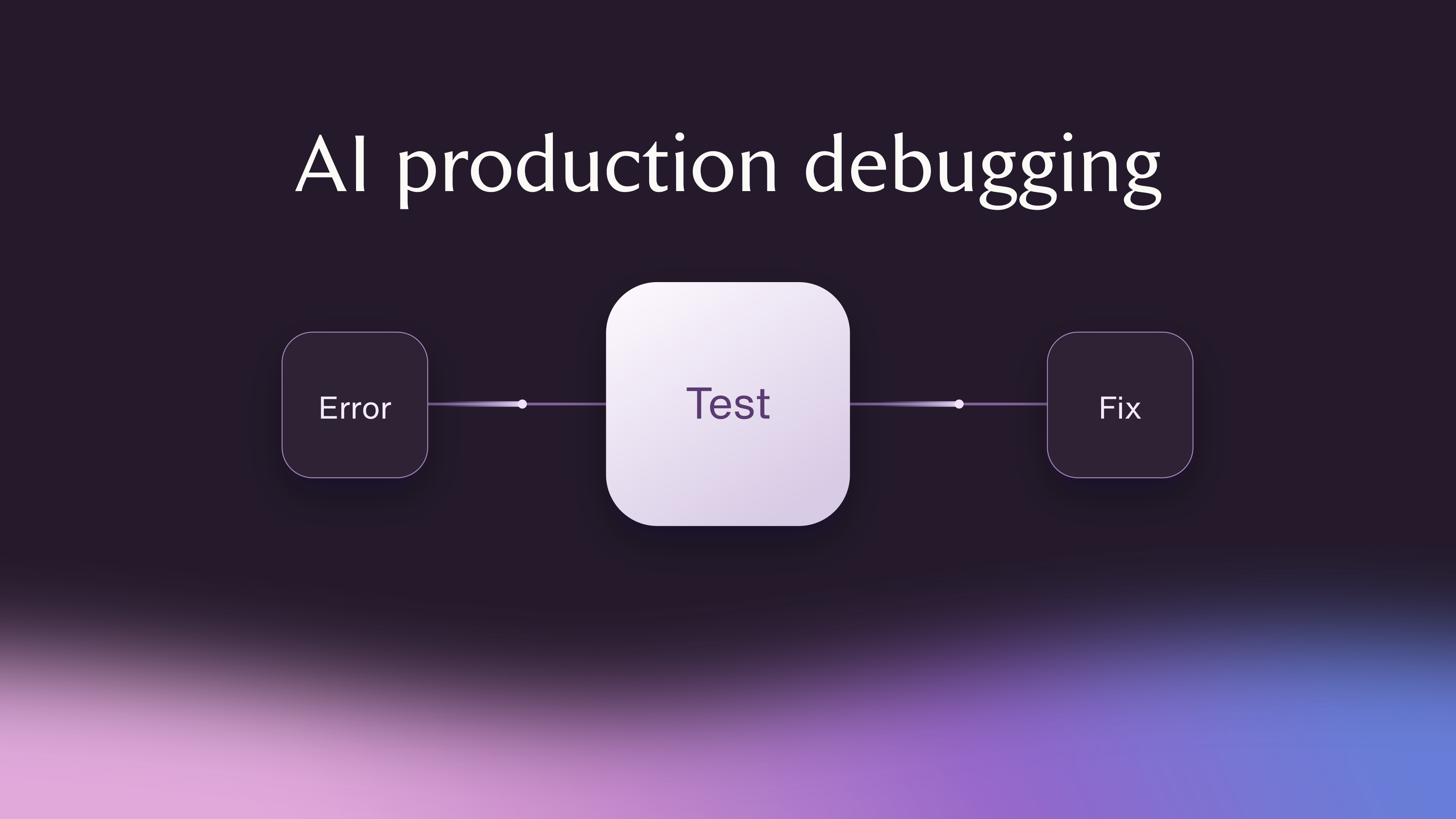
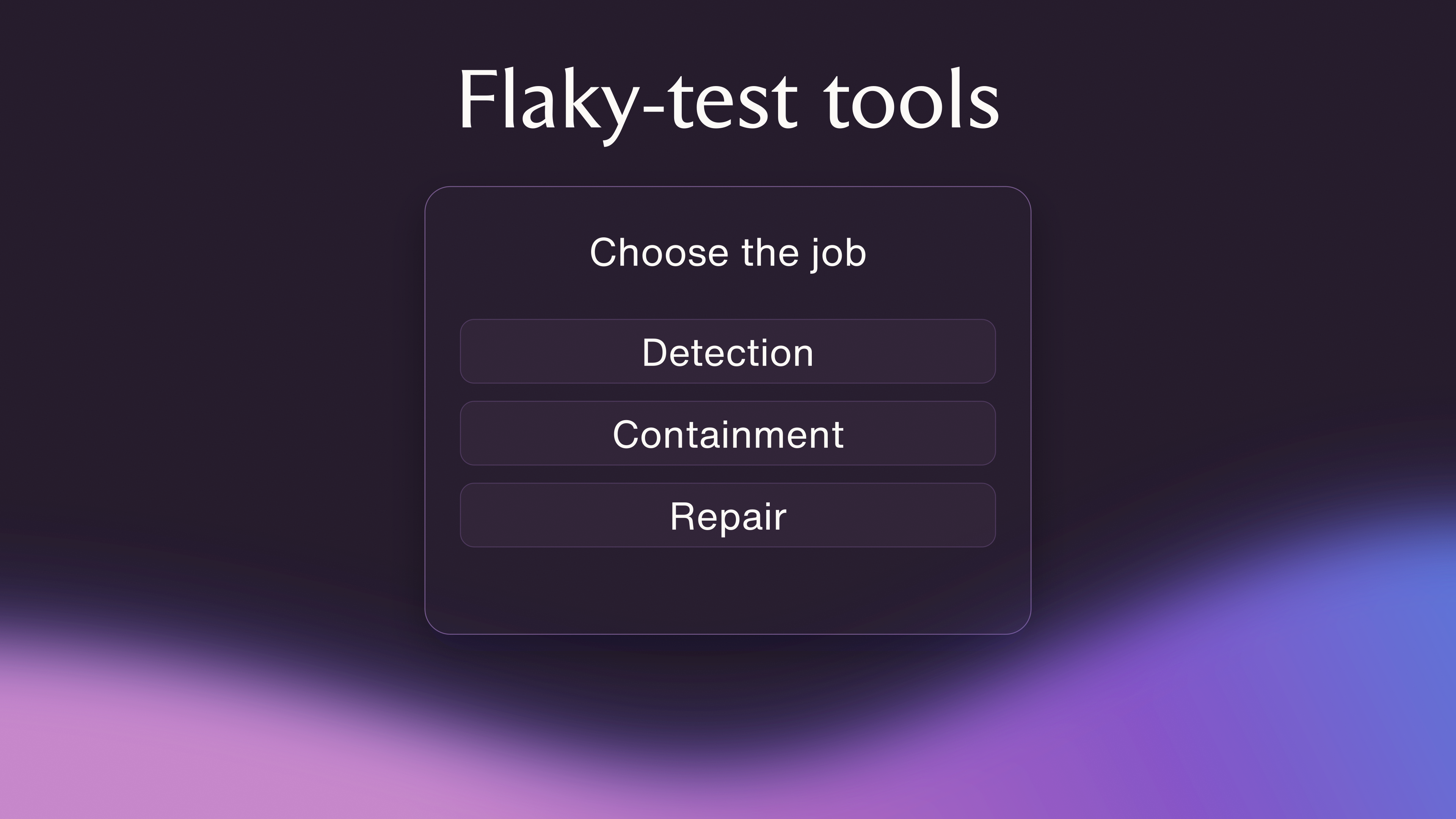
A test that fails and then passes on the same commit creates two jobs: keep the intermittent failure from disrupting delivery, and find out why it happened. The best flaky-test tool for your team depends on which job is going unfinished. Historical detection, quarantine, prevention and code repair deserve a place in the decision.
For GitHub Actions teams already using Claude Code or Codex, Artie's Gilfoyle is a strong fit when a fail-then-pass check or a repeatedly retried test needs investigation through a cause-level fix and repeated runs. Trunk, Currents and Datadog connect richer test context to repair in different ways. Buildkite, BuildPulse and Mergify also address the operational work of finding and containing unreliable tests.
Artie publishes this guide and is included among the options. This is a comparison of documented workflows, not a hands-on benchmark or a universal ranking.
Decide what a successful result looks like
Compare the options on five things: how they detect intermittent failures, how they keep delivery moving, how they prevent new flakes, what evidence reaches the repair process, and what comes back for review. A tool can cover several of those jobs. Buying a dashboard and buying a repair workflow are different decisions, even when one product supplies both.
Quarantine can stop a known unreliable test from blocking builds while its owner investigates. Retries can keep work moving too. Neither action, by itself, demonstrates that the underlying race, leaked state or external dependency has changed. A useful repair result connects the failure pattern to a code change and shows what was exercised afterward.
Gilfoyle: take an intermittent failure through repair
Gilfoyle's flaky-test workflow starts when a check fails and then passes on rerun, or when you name tests the team keeps retrying. The connected evidence comes from GitHub Actions run history and logs. Gilfoyle compares failed and passing runs of the same commit, looking at timing, test order, shared state and external calls.
With connected Claude Code or Codex and a runnable test environment, he reproduces the triggering conditions, such as parallel execution or a fixed random seed, and changes the cause the evidence supports. The returned draft PR explains the cause, the change and repeated runs before and after. If reproduction fails, the result is the evidence gathered and the next diagnostic step. Your reviewers decide what merges and whether a retry is appropriate.
This fits a team that wants an established repair job in its existing GitHub and coding-agent environment, without adopting a separate flake-tracking platform or building a webhook-to-agent pipeline. The value is carrying an intermittent failure from its trigger to a reviewable repair.
Trunk: connect test history to your own repair pipeline
Trunk is worth considering when historical test context needs to feed an agent workflow your team controls. Its flaky-test repair guide describes a pipeline you build and run: start an agent from a status-change webhook or a scheduled query, retrieve the test's history and failing runs, open a root-cause repair PR, then keep monitoring the test.
That is substantive repair support, not merely a list of failures. Trunk supplies the context and instructions for your agent. Its MCP tools provide another route into investigation. The API guide's failure-log excerpts require CI Intelligence to be enabled for the repository. Otherwise, it directs the agent to the build URL.
Choose this route when your team wants to shape the repair pipeline around its test telemetry and ownership rules. Gilfoyle's defined GitHub Actions repair workflow is attractive when you want to hand over that particular job rather than assemble the pipeline yourself.
Currents: bring Playwright evidence into your agent
Currents' AI workflow is especially relevant to Playwright teams. It gives agents errors, steps, console and network logs, screenshots, videos, traces and test history. That context can explain what the browser actually did when a test failed.
Its repair handoff can start from the dashboard, a link, Slack, a pull request comment, an IDE or an MCP prompt. Your agent uses the failure context to reproduce the problem, repair it and rerun the test. Currents also supports before-and-after proof and sharing the recorded evidence with reviewers.
The buying reason is the combination of Playwright context and a direct path into the agent you use. If the evidence you need already lives in Currents, that is a strong basis for the repair workflow.
Datadog: native autonomous repair from test signals
Datadog combines flaky-test history and detection with a native coding agent. Bits Code explicitly supports fixing flaky tests in Test Optimization and verifying that they remain stable. It can run on a schedule or respond to product signals, then return a pull request or other configured output.
Bits Code also iterates on changes using CI logs and developer feedback. It does not automatically merge PRs. For a team already using Datadog Test Optimization, this is a substantial end-to-end option: test signals can lead to a code change and stability checks inside the same product environment.
Buildkite: manage reliability in the pipeline you already run
Buildkite Test Engine uses historical test data to detect unreliable tests, quarantine them, notify the responsible team and recognize recovery. Quarantined tests can continue producing data, and recovery actions can remove flaky labels and restore tests when reliability improves.
Its MCP server also gives connected agents investigation, log and build actions. Connecting the server is not itself a running watcher. Buildkite belongs on the shortlist when the team wants reliability management close to its existing pipelines, with agent access available for investigation and action.
BuildPulse and Mergify: contain disruption and prevent new flakes
BuildPulse ingests test results, correlates them across builds and commits, and prioritizes flakes by disruption. It supports quarantine, alerts and linked issues with failure history. That is a practical fit when your first problem is knowing which unreliable tests to fix and keeping the worst offenders from blocking work.
Mergify Test Engine emphasizes mitigation inside the test job, prevention checks for tests added or changed in a pull request, and quarantine with recovery. Its merge queue uses the same retry and quarantine handling, while its CLI gives coding agents test-health context. This fits teams whose flakiness problem is tightly connected to merging changes and preventing new unreliable tests from entering the suite.
These are distinct strengths. Prioritizing a backlog of flaky tests, containing a failure during execution and changing the code that causes it can all be valuable. Keep the intended outcome visible when evaluating a vendor's use of the word “fix.”
Existing platforms, baseline controls and direct coding agents
If your team already uses Develocity or Cypress Cloud, include that existing platform in the buying decision before adding another test system. Native CI rerun controls and open-source detection approaches belong in the baseline too. A selected shortlist should account for what you already operate, without assuming those options either solve every stage or lack repair capabilities.
Direct coding agents such as Claude Code, Codex, Cursor and Devin are also genuine repair routes when they have the relevant logs, repository and runnable environment. A developer can conduct the investigation in that session. Connected assistants can continue work and take permitted actions as well. The decision is how failure context reaches the agent and who supplies the surrounding workflow.
What a useful returned repair looks like
Fictional example: two browser tests share a cart fixture. Checkout passes alone, but fails intermittently when a neighboring test resets the cart during parallel execution. The following is an illustrative repair handoff, not a recorded Artie run.
Cause: checkout and cart-reset tests mutate the same cart. The failure appears when reset runs between checkout's item selection and payment assertion. The investigation separates that shared-state pattern from a slow response or a broken payment assertion.
Change: give each test its own cart fixture and remove the shared reset from the checkout suite. Keep the payment assertion intact. This addresses the interference rather than making the assertion easier to pass.
Returned evidence: the draft PR includes the failing and passing run references, the parallel reproduction command, the fixture diff and the before-and-after repetition logs. Its review note identifies which paired tests, browser and execution conditions were exercised, and which remain outside the check. A reviewer can inspect why the change should work instead of relying on one green rerun.
That is the difference between a convenient rerun and a useful repair deliverable. Repeated successful executions increase confidence under the exercised conditions. They do not prove that every possible intermittent failure is gone.
Choose the missing part of your reliability workflow
Use historical detection and containment when the team cannot see or prioritize its flaky-test backlog. Give native repair options such as Datadog, and agent-connected routes such as Trunk and Currents, full weight when their test evidence already supports your work. Buildkite, BuildPulse and Mergify offer different ways to keep unreliable tests from repeatedly disrupting delivery.
For a GitHub Actions team that needs fail-then-pass checks or named recurring flakes investigated through a cause-level change, give Gilfoyle the flaky-test repair job. The purchase is a concrete returned result: the cause, the change, the repeated checks and the unresolved evidence your reviewer needs.