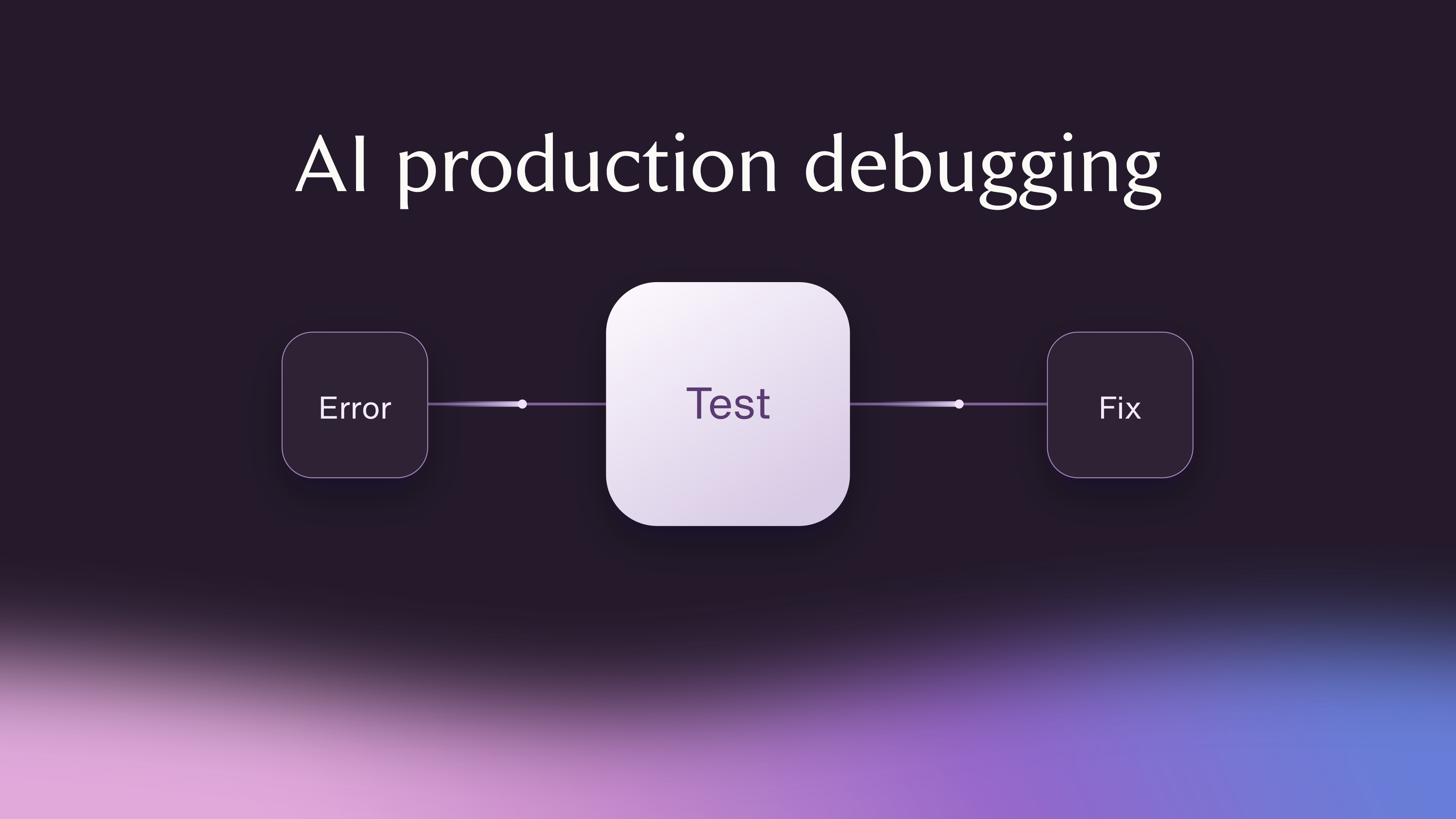
A production error needs more than a plausible explanation. Your team needs to know what failed, whether a change fixes it, and whether production recovered after that change shipped. AI production debugging tools can help carry that work, but they start with different evidence and take different routes to a repair.
For an engineering lead with application errors in CloudWatch, a GitHub repository, and connected Claude Code or Codex, Artie's Gilfoyle is a concrete choice: assign the error investigation and get a supported reproduction, a focused regression test and a draft fix for review when the failure is reproducible. The review starts with evidence of the failure and a proposed way to prevent its return.
This guide compares AI-assisted production investigation and repair, rather than conventional debuggers or the whole incident-management market. Artie publishes it. The recommendations use documented workflows, not a hands-on performance ranking.
Choose around the evidence and the repair
Use four criteria: where the agent gets production evidence, how it tests a diagnosis, what code or operational change it can prepare, and how it checks the result. A patch that passes CI and a service that has recovered answer different questions. Your shortlist should cover both.
The right starting point depends on the work you want to assign. An application exception can lead to a code fix. A deployment regression can require a rollback. A missing runtime value can demand new evidence before either action makes sense. Choose a tool that can reach the relevant signals and deliver the next engineering decision with supporting evidence.
Gilfoyle: give an application error a repair owner
Gilfoyle's production-error workflow connects an accessible signal, such as CloudWatch logs or configured Slack alerts, to the relevant repository, environment and release. Through connected Claude Code or Codex with GitHub, it builds a supported reproduction and a focused regression test, then records the diagnosis, tests and release considerations in a draft pull request.
That is a useful assignment for a lean engineering team: turn this application error into a change we can evaluate. Reviewers get a failure they can reason about, a test intended to catch its return and a patch tied to that evidence. In the normal workflow, required reviewers and the authorized release owner decide what ships. After an approved release, Gilfoyle checks accessible logs alongside the owner's checks before the incident is closed.
There is also an opt-in Automatic fixes option for CloudWatch. With GitHub and Claude Code connected, teams can enable it so Gilfoyle investigates errors, makes code fixes and checks recovery after deployment. This option does not by itself establish automatic production deployment. Additional production authority must be explicitly configured.
The useful boundary is evidence. If the cause points outside the code, or the needed access is unavailable, the handoff becomes the diagnostic gap, affected path and next step. Gilfoyle should not manufacture a patch for an external-provider failure. Its detection coverage and timing follow the signals and access you supply.
Sentry Seer and Datadog Bits: repair where the telemetry already lives
Sentry Seer's Autofix combines issue details, traces, logs and profiles with connected repositories. It can identify a cause, generate a solution and open a PR. Configured automation handles eligible issues through a selected stopping point. Its automatic-run conditions include at least ten events, recent occurrence and sufficient assessed fixability.
Seer also follows through on the fix. It supports multi-repository changes, GitHub PR iteration on CI failures and reviewer feedback, and handoff to coding agents such as Claude Code, Cursor Cloud Agents and GitHub Copilot. You can ask it to add a regression test. Choose Seer when your team already investigates these failures in Sentry and wants that issue context to carry into implementation and revision.
Datadog Bits Remediation connects an investigation to code fixes, triage and infrastructure actions. With Bits Code configured, it can automatically generate suggested fixes for code-related causes, with optional auto-push to open PRs. It also supports governed operational actions and verification of whether the original issue was resolved.
Choose Bits when the incident evidence and operational work already sit in Datadog. Infrastructure one-click actions are in Preview, require applicable guardrails, and availability varies by Datadog site. That matters if your immediate need is an agent that applies a rollback, rather than one that prepares a code change.
For teams already investigating these failures in Sentry or Datadog, both are natural repair paths.
Cleric and Rootly: carry production context through the fix
Cleric leads with checking how changes behave in production. It tracks PRs into deployment, keeps checking for delayed regressions, and investigates failures that tests missed. It also handles urgent pages and lower-priority alerts.
Its repair workflow is substantial: review a fix PR with production evidence in Cleric, then have it check recovery after deployment. Alternatively, bring the investigation and production context into Claude Code or Cursor over MCP, or send the findings into an issue. Access is read-only by default, with write access available when configured. Choose Cleric when tracking production changes and continuing to verify their behavior is the responsibility you want covered.
Rootly AI SRE places repair within incident response. It can hand a fix to Claude Code, Codex, Cursor or Devin for a PR, then confirm recovery on the signal that originally fired. Its illustrated workflow includes CI and load-test checks on the fix PR, followed by proposed testing improvements after the incident.
Choose Rootly when investigation, the fix, recovery confirmation and the retrospective should remain connected to the incident workflow. Its repair capabilities matter even if you are comparing tools primarily for debugging.
Cleric and Rootly also connect investigations, coding tools and recovery checks. The difference is the shape of the job. Cleric centers on verifying production changes, and Rootly on the incident workflow. Gilfoyle takes one application error as an assignment, with the incident owner, required reviewers and release authority named up front, and returns the reproduction, test and draft PR to that team.
AWS DevOps Agent and ResolveAI: investigate across operational context
AWS DevOps Agent belongs on a CloudWatch team's shortlist. It investigates alerts, correlates operational context with code and deployments, provides root-cause analysis and mitigation steps, and produces agent-ready specifications for implementation by a coding agent or colleague. Its integrations span observability tools, repositories and CI/CD, with MCP and A2A extensions and custom agents.
Choose it for AWS-connected investigation and implementation handoff across application and infrastructure concerns. Its scope also includes multicloud and on-premises environments. The separate release-management testing offering is in Preview. For a CloudWatch team, the practical split is the deliverable. AWS documents implementation handoff as agent-ready specs for a coding agent or colleague. Gilfoyle's documented handoff is the reproduction, test and draft PR.
ResolveAI's incident agents investigate in parallel, verify findings against production evidence and let engineers steer the investigation in Workbench. Engineers can approve commit reverts, GitHub Actions and alert silencing from the same surface. ResolveAI also describes handing production context to coding agents to address recurring root problems.
Choose ResolveAI when a failure needs several lines of investigation and engineers need to redirect the work as evidence arrives. The combination of engineer steering, verified findings and approved remediation suits an investigation whose direction can change as the team works.
HyperProbe and Traversal: when the missing evidence changes the choice
HyperProbe addresses a different obstacle: the logs may never have recorded the value that explains the failure. Its workflow accepts alerts, reads logs and traces, then uses read-only probes to capture live variable state at a suspect line. It describes working with coding agents to collect that runtime evidence without redeploying the service.
Choose this route when a silent failure, swallowed exception or timing-dependent bug needs evidence from the running application. Its read-only description applies to the probes. Memory-leak, OOM, CPU-spike and latency-spike features marked as shipping this month should be confirmed before relying on them.
Traversal covers cross-stack diagnosis and remediation. It describes tracing incidents across services, dependencies and changes, automated remediation, and feeding production context back into development. It runs on top of existing observability tools with read-only access by default.
Choose Traversal when understanding the production system across dependencies is central to the repair. Its scope includes acting on diagnoses. The practical distinction from a focused application-error assignment is the breadth of operational context you want the system to handle.
Incident platforms and direct coding agents also belong in the decision
PagerDuty's Paige combines cross-tool signals with incident context, routes responders, runs available runbooks and applies approved resolutions with outcome reporting. Deep Investigation and SRE Workbench are Preview offerings. Its page gives mixed signals on broad autonomous-resolution availability, so confirm that separately if it drives your choice. PagerDuty is relevant when coordinating responders and operational recovery is the larger need.
Komodor's agentic operations platform spans AI SRE, code root-cause fixes and governed custom agents, including workflows using Claude Code or Codex. It supports triggers such as alerts, schedules, chat and pull requests. Consider it for a broader cloud and infrastructure operations program that also needs application repair.
You can also use Claude Code, Codex, Cursor or GitHub Copilot directly with the necessary production context, repository access and tests. The Sentry, Cleric and Rootly handoffs show how coding tools can participate in a real production-repair workflow. General assistants can support continuing connected work too, including scheduled or event-driven tasks. Choose a composed workflow when your team wants to own how signals, implementation, review and recovery checks fit together.
What the engineering handoff should make clear
Consider a hypothetical missing-field regression after a checkout release. A payload without an optional address field now throws an exception. This is an illustration, not a product test.
For the Gilfoyle assignment, the valuable result would connect the error timestamps to the release diff, reproduce the failing payload where supported, and include a focused test covering both the missing field and a normal payload. The draft PR would show the change and check results, giving the code owner a concrete basis for review.
That still leaves a release decision and a recovery decision. The authorized owner ships the approved change. Accessible logs over the agreed observation window, together with the incident owner's checks, establish whether the error stopped.
Choose the repair job you want to hand over
Choose Gilfoyle when you want an engineer to turn a CloudWatch application error into a supported reproduction, focused regression test and reviewable GitHub fix through connected Claude Code or Codex, when the failure is reproducible. Its value is a concrete repair handoff your team can review and carry through release, with the outside-code or missing-access gap made explicit when a patch is not supported.
Choose Sentry or Datadog's native agents when that is where your useful telemetry already lives. Choose Cleric for continued production-change verification, Rootly for repair within the incident workflow, and AWS DevOps Agent for AWS-connected investigation and implementation handoff. ResolveAI and Traversal address broader operational investigations and remediation. HyperProbe is relevant when the next step is capturing runtime evidence the logs do not contain.
For the focused application-error assignment, give Gilfoyle the production repair job. Start the review with evidence of the failure and a test intended to catch its return.