The right applicant screening tool depends on what your team needs to learn. Reviewing a resume, evaluating a written application answer and asking someone to demonstrate a skill are different jobs. A useful shortlist preserves those differences instead of treating every score as the same kind of evidence.
For Greenhouse teams whose hiring bar depends on substantive application answers, Artie's Nick is a strong choice: he reviews resumes and answers against approved criteria, returns cited reasoning and leaves candidate decisions with your team. Native ATS tools suit review within an existing recruiting system. Assessment and interview platforms belong on the shortlist when the application itself cannot answer the hiring question.
Artie publishes this guide and is included among the options. The comparisons use input evidence, criteria, returned work, reviewer control and integration requirements, rather than a universal ranking.
Start with the question the application cannot settle
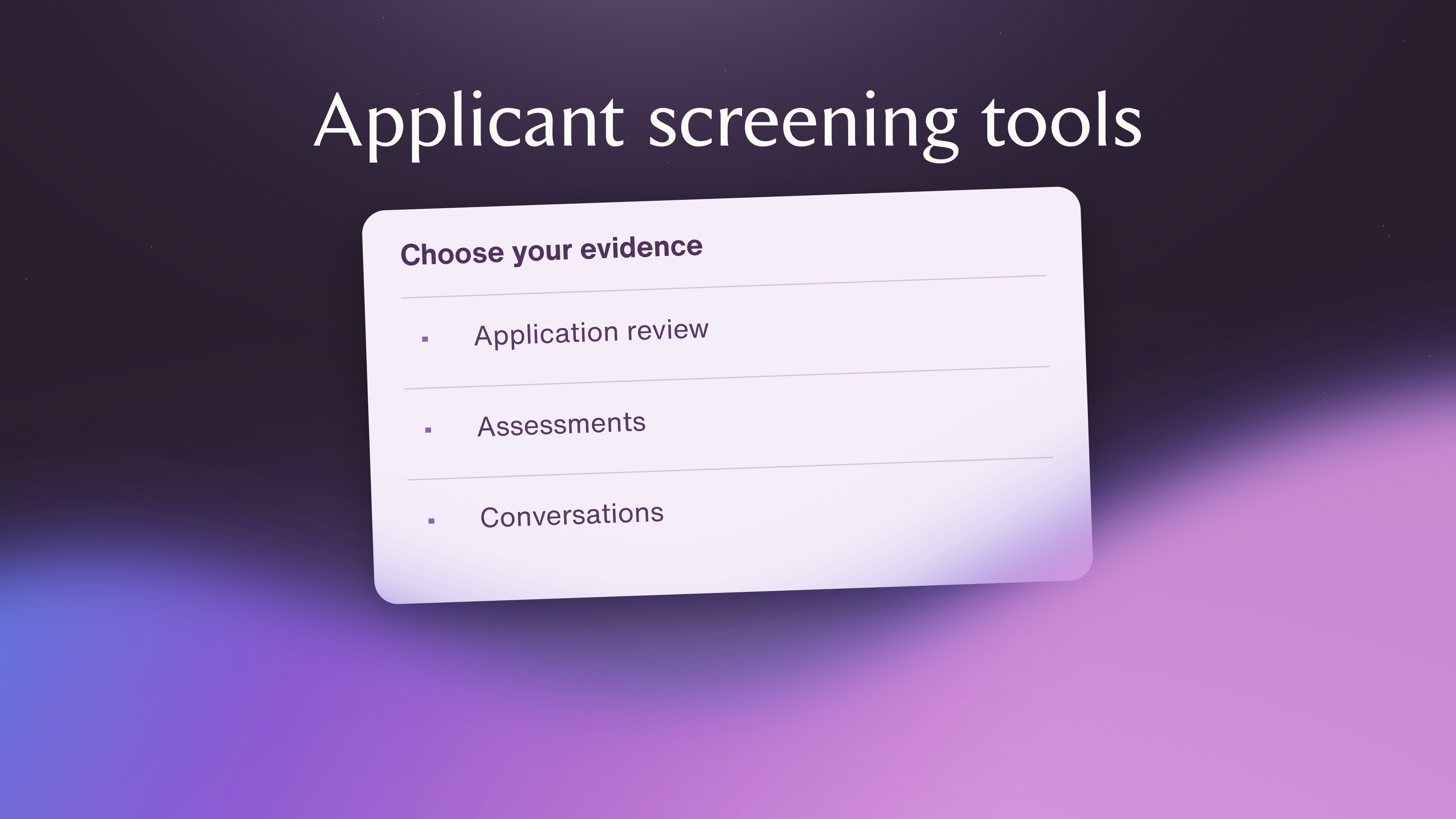
An applicant screening tool can organize evidence you already have or collect evidence you still need. Decide which job matters before comparing features.
Review existing applications: Match experience and written answers to the hiring bar, with reasons a recruiter can inspect. Consider Nick, Greenhouse, Ashby, Workable, HiPeople, SeekOut and Metaview Application Review.
Gather assessment evidence: Ask candidates to complete relevant tests or exercises. Criteria and HireVue cover this branch, while Willo also offers assessments alongside structured responses.
Explore answers in conversation: Use screening interviews or asynchronous responses to investigate experience, reasoning and communication. Metaview Screening, HireVue and Willo offer different ways to collect that material.
These approaches can work together. A missing detail in an application may call for a follow-up question, while a requirement to demonstrate a skill may call for an assessment. Neither should quietly become a conclusion that the candidate lacks the skill.
Nick: cited review of Greenhouse resumes and answers
Artie provides AI employees with work computers, connected apps, shared company knowledge and ongoing responsibilities. Nick's applicant screening workflow brings that model to a concrete recruiting assignment: review new applications in selected Greenhouse jobs against your written hiring bar.
Nick starts with must-haves, nice-to-haves and explicit exclusions for information that must not be used. If the criteria are vague, he brings back questions before reviewing applicants. He then reads each resume and its application answers, records the evidence for each criterion and cites where the information came from.
The returned work groups applicants into meets must-haves, missing a must-have and needs review, with reasoning and suggested recruiter questions for unclear evidence. Advancement, rejection and candidate messages stay with your team or wait for its approval. That makes Nick a useful fit when the recruiter needs to inspect the connection between a hiring requirement and a substantive answer, rather than receive a score alone.
Consider a hypothetical backend-engineering application. The resume lists a payments service, while an application answer describes the applicant's own on-call responsibilities. A useful review ties those two passages to separate criteria and flags any unclear personal contribution for a recruiter question. The team gets an evidence trail to review, not an inferred rejection from an incomplete resume.
Greenhouse itself already offers explained matching, calibration and human decisions. Workable evaluates application answers too, and HiPeople combines context, evidence logs and follow-up clarification. Choose Nick for a Greenhouse handoff built around clarified criteria, explicit exclusions, cited evidence across resumes and answers, and team-controlled candidate actions. Recurring reviews and Slack delivery are useful parts of the work, shared with other agent-based recruiting approaches.
The workflow requires read access to the connected Greenhouse jobs. Notes or tags are optional permitted actions, and a Google Doc can supply the hiring bar. Teams can work in Artie or Slack. Artie pricing is usage-based, with possible connected-app costs, so there is no fixed per-applicant saving to assume.
Greenhouse Talent Matching: explained review inside the ATS
Greenhouse Talent Matching is a substantial native option. Recruiters set weighted criteria, receive match categories and explanations, inspect highlighted resume evidence and override results. Calibration history preserves changes, and applying an updated calibration recalculates current Application Review candidates. Hiring decisions remain with recruiters and hiring managers.
The beta Talent Matching assistant can start from the job post and scorecard to propose calibration and filters. It helps prepare the review setup. The matching engine then evaluates candidates. The Real Talent add-on, eligible Core, Plus or Pro subscription and relevant permissions apply.
The important input distinction is precise. Greenhouse's published data processing FAQ says the matching algorithm uses only resume data and excludes structured application-form data from that calculation. Filters, keyword search and the Past candidates tab are separate from this matching calculation.
Choose the native matching workflow when resume-based prioritization with explanations answers your review question. If a substantive application answer is part of the hiring bar, Nick's review of that answer alongside the resume is a concrete reason to add him to the Greenhouse workflow.
Ashby: custom criteria in application review
Ashby's AI-assisted application review lets teams create custom resume criteria, accept suggested criteria or reuse criteria from other roles. Results show meets, does not meet or undecided, with reasoning for each criterion. Recruiters can filter evaluations and re-evaluate active candidates after changing criteria.
Its application-form check has a narrower job: determining whether a long-text question was answered. Blank or unrelated answers fail that check. It is not a substantive evaluation of the answer against a hiring requirement. That distinction matters if your team asks applicants to explain a project, decision or personal contribution.
Ashby fits teams that want criteria-led review within their existing ATS. The feature is available across Ashby plans with AI credits and appropriate permissions. A credit covers a candidate evaluation, so include re-evaluation needs when considering usage.
Workable Agent: application review plus clarification
Workable Agent evaluates CVs, candidate profiles, application answers and custom fields against an ideal candidate profile. It returns criterion-level reasoning, including unknown states, and can ask applicants for missing details through chat. Optional actions include advancing or disqualifying candidates under configured rules, with recruiter review and overrides.
This is a strong option for Workable teams that want screening and candidate clarification in the same system. It overlaps directly with evidence-led application review and goes further into candidate contact when enabled. Access requires a paid Recruiting account, AI credits and an agentic job. The current workflow supports English.
Changing the hiring bar also has a practical consequence. Under Workable's “Keeping candidates in sync” behavior, new and in-flight candidates use the updated criteria. Already sourced or applied candidates retain their existing evaluation and show a previous-version banner. Re-evaluating one against the new criteria is a manual action that consumes an AI credit.
HiPeople and SeekOut: recurring review with follow-through
HiPeople brings recruiting context from ATS scorecards, documents and Slack or Teams intake into its agents. Its application screening returns evidence logs, supports reviewer overrides and can turn findings into interview guides. It can also contact applicants to clarify unclear details and bring their answers back, with configurable next actions.
That makes HiPeople a direct alternative for teams that want a recurring, contextual review and follow-up process. Its context intake and configurable actions suit teams that want the agent to carry evidence into the next recruiting step.
SeekOut Applicant Evaluation & AI Screening continuously evaluates inbound applicants against role requirements, supplies plain-language explanations and routes candidates with match summaries. Its screening questions adapt to candidates' backgrounds, with responses summarized and scored for recruiters. The fit is a connected evaluation-to-screening process with people retaining candidate decisions.
For either option, compare the actual returned evidence and permitted next actions with your team's preferred handoff. An agent that asks applicants questions is a different operating choice from one that sends suggested questions to a recruiter for approval.
Metaview: application review and screening conversations
Metaview Application Review groups applicants by ideal-candidate-profile fit, provides rationale through criterion-specific columns and supports ongoing evaluation and feedback. Greenhouse is among its supported ATS integrations. It belongs in an application-review shortlist as well as an interview shortlist.
Its separate Screening agent collects new evidence through voice conversations. Teams define questions and a rubric, candidates complete the screening, and reviewers receive recordings, transcripts and rubric scores. The conversation can include adaptive follow-ups, role-play scenarios or explanations of code shown during the interview. Humans make the progression or rejection decision.
Choose between those jobs deliberately. Application Review organizes the material already in the pipeline. Screening is relevant when you need to hear how a candidate explains their contribution or responds to a role-specific scenario. A transcript and recording give reviewers something different to examine from a resume match explanation.
Criteria: assessments as a separate source of evidence
Criteria offers assessments across cognitive aptitude, personality, emotional intelligence and skills, alongside asynchronous and live video interviewing and an AI scoring add-on. The buying reason is access to assessment and interview formats that ask candidates to supply new evidence.
For a team whose unresolved question concerns a particular skill, this branch deserves its own evaluation. Look at what the candidate will actually be asked to do, what the reviewer receives and how that information relates to the role. An application-review agent can cite a claim about experience. It does not turn that claim into a completed skills assessment.
HireVue: interviews and assessments in one selection workflow
HireVue combines AI Interviewer, assessments, video interviewing and ATS integrations. Its AI interviews use voice conversations and adaptive follow-up questions. Its assessment offering includes skills tests and game-based assessments, while video interviewing supports structured interviews and summaries.
HireVue belongs on the shortlist when the team wants interview and assessment stages within a broader selection platform. The evaluation should focus on the candidate experience, the kinds of responses or tasks collected, and the evidence reviewers use across those stages. That is a broader purchase than adding a resume-review feature to an ATS.
Willo: structured responses candidates complete asynchronously
Willo combines structured candidate responses, ready-made or custom assessments, transcripts, summaries and role-specific comparisons. Candidates can submit responses in their own time, and teams review them against their success criteria. Its formats include video, written answers, file uploads and multiple choice, with ATS integrations connecting the work to the hiring pipeline.
This suits teams that want candidates to answer a defined set of questions without a live screening conversation. Willo is more than a video recorder: the assessment structure and review material are part of the purchase. Compare that asynchronous format with Metaview's adaptive voice conversation and HireVue's combined interview and assessment workflow.
General assistants can participate too
Claude Cowork, ChatGPT Work and Perplexity Computer can work with files, connected tools and recurring responsibilities. They are plausible options for organizing application material and preparing review artifacts. SeekOut's MCP connection also brings recruiting capabilities into supported assistants.
The practical distinction is the working connection and returned review. File access alone does not establish access to your ATS or permission to contact applicants. If your team chooses an assistant-based route, evaluate the actual criteria, evidence citations and next actions it can support in that environment, using the same standard as a dedicated tool.
Choose the evidence and the handoff together
Start with the question a recruiter needs to answer. If the application contains the relevant evidence, compare the tools that can read the right fields and explain their findings. If it does not, choose an assessment or conversation that gathers the missing material.
For Greenhouse teams that rely on detailed application answers, Nick offers a clear handoff: the hiring bar clarified before review, evidence cited across resumes and answers, unresolved points turned into recruiter questions, and candidate actions kept with the team. Ask Nick to review inbound applicants against the criteria your team actually uses.