
Artie and ChatGPT Dots both support ongoing work, context and computer-based execution. Evaluate Artie when responsibilities belong to a team of people working with named AI employees. Evaluate a dot when one person wants an agent that follows their priorities across conversations and tasks. The distinction is ownership and participation, not whether the agent can act without a fresh prompt.
This comparison covers Dots, OpenAI's persistent personal agent. If your question is about producing a report, spreadsheet or other project deliverable, read Artie vs ChatGPT Work. A dot can coordinate Work and Codex tasks, but Dots and Work are different experiences.
Artie is our product. This is a documentation-based comparison checked on October 10, 2026, not a hands-on benchmark. Prices below are in USD. The fictional exercise below gives review criteria, with no claimed vendor results.
Artie for responsibilities colleagues share
Artie offers employees with work computers and company knowledge within granted access. Its role catalog supports custom employees as well as specialists. The published communication surfaces include Slack, text, WhatsApp, email, phone calls and Google Meet.
For example, a customer success lead and operations manager may both need to work with the employee preparing an account-risk brief. One supplies account context, the other changes the reporting rule. Evaluate Artie when those people need a continuing shared responsibility rather than asking one person to relay every instruction.
A dot follows its owner across work
OpenAI describes a dot as an always-on personal agent with its own cloud computer. It can coordinate background work and use relevant ChatGPT memory alongside its own saved notes. Those notes carry preferences and decisions across conversations, rather than being a complete record of everything the owner has ever said.
That can suit a founder who wants one agent to follow several priorities, connect a new message to ongoing work and return with a decision. It can also support business assignments. Enterprise availability and administrative controls mean personal ownership should not be mistaken for consumer-only use.
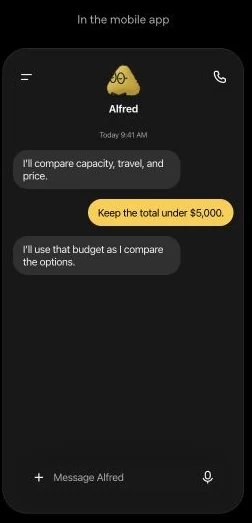
OpenAI’s mobile example shows the owner adding a $5,000 budget to an ongoing comparison. Source: OpenAI.
The collaboration boundary is specific: OpenAI's Enterprise guide says only the owner can direct a dot through supported Slack messages or mentions. Other participants' messages may provide context. A dot appearing in a shared thread is therefore not the same as a common employee that every colleague can independently instruct.
Communication and availability can decide the shortlist
You can message or call a dot in ChatGPT and connect supported channels. The messaging guide currently lists texting as coming soon and dot-initiated calls as planned after launch. The Enterprise guide limits Microsoft Teams to an invite-only alpha. Do not assume a ChatGPT voice call is a general phone number that customers can call.
Artie publicly describes making and receiving phone calls and joining Google Meet. These are concrete capabilities to evaluate if the job includes a supplier call or a meeting with colleagues. They do not establish that every call, number, region or meeting workflow will work without setup.
Pricing is a workspace-versus-subscriber decision
Buying detail | Artie | ChatGPT Dots |
|---|---|---|
Entry option discussed here | Artie Team: $100/month for the workspace | ChatGPT Pro 100: $100/month for one subscriber |
Other published options | Larger credit allowances and Enterprise plans | Pro 200: $200/month, Pro 500: $500/month |
Managed company option | Team has no separate seat fee | Business Premium: $125/user/month monthly or $100/user/month annually |
Usage | 10,000 shared credits on the $100 plan | Dot conversation and delegated task usage are treated differently |
Entry | Public waitlist | Gradual rollout to eligible plans and regions |
Sources: Artie pricing, ChatGPT Pro tiers and Business Premium. New Business workspaces require at least two paid seats. Standard and Premium seats can be mixed to meet that minimum, but Standard does not provide the Dots eligibility described here. Artie's phone calls use 10 credits per minute. Video and meetings use 20 per minute after the free launch period, with work performed during calls consuming credits too.
The Dots access guide lists Pro 100, 200 and 500 for adults outside the EEA, UK and Switzerland. Business Premium and Enterprise are rolling out worldwide, with Enterprise requiring administrator enablement. Eligibility does not mean immediate access.
Conversations with a dot do not count toward ChatGPT usage limits. Tasks it starts or manages in Work or Codex use those products' allowances, and deeper work has its own allowance. Do not budget unlimited execution from the conversation rule. Several employees needing their own eligible accounts also changes the comparison with a shared Artie plan.
Test who can correct an ongoing responsibility
Use a fictional release brief with two audiences. Product lead Priya targets October 27, pending Noah's QA result on October 14. Maya approves external messaging. Customer-operations reviewer Owen records that customer Alder has asked about readiness, but no date has been promised. Lena owns the internal response draft, due October 15.
Ask for a company-wide decision list and a separate restricted note for Maya and Owen. The company version must not identify Alder. For round two, Priya moves the target to November 3 and the QA result to October 19. Have Owen supply that correction and ask for an owner beside each next action. Both drafts should use the revised dates while keeping the customer details restricted and readiness unresolved.
For a dot, have its owner bring the colleague's correction into the supported conversation. For Artie, use the team route you intend to adopt. Record the handoff honestly, including any relay through the owner. The goal is to find a workable process, not force identical behavior.
If the dot owner can manage the responsibility comfortably, its personal continuity may be exactly what you need. If that person becomes the relay for many colleagues, evaluate Artie's shared employee approach. Either way, confirm that any recurring check was actually saved and inspect the next output after the correction.
To explore Artie, join the waitlist with a responsibility shared by two colleagues. Keep the first run to drafts and review who can see its sources. A personal agent and a team employee both need clear access and human judgment.