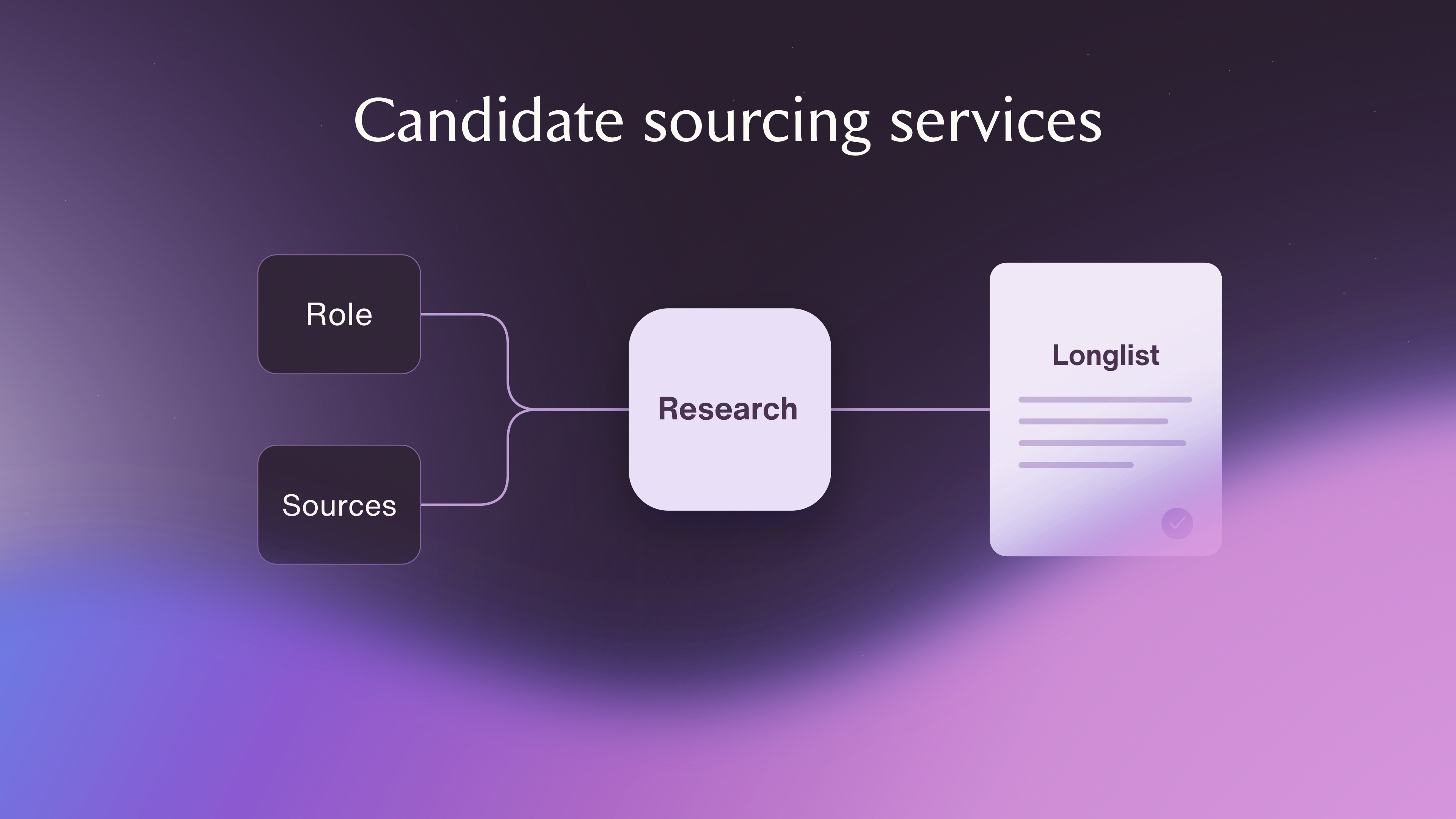
Candidate sourcing services sell different amounts of the hiring work. One engagement might deliver a researched longlist for your recruiters to assess. Another includes outreach, interest confirmation and qualification. The useful buying question is how much of that work you want to commission, and what your team wants to retain.
Artie is a strong choice when your team wants candidate discovery done inside its existing workspace and will review the work evidence itself. Give Artie the role criteria, permitted sources and examples of relevant work. It can save a source-linked sourcing batch to the task, summarize what it found and continue that same batch when you ask. Your recruiters get evidence to investigate and a saved assignment to develop.
Artie publishes this guide. We compare its AI employee route with Cruvo's reviewed research, Talent IQ's pipeline and outreach tiers, and Audentia Research's sourcing and engagement service. These are different scopes of work, rather than a ranking of candidate quality.
Decide what the sourcing handoff should contain
Start with the point at which your team wants to take over:
Candidate discovery: People to investigate, with sources and relevant work evidence. Your team assesses whether they meet the role and decides whom to approach.
Reviewed research: A longlist assessed against an agreed brief, with reasoning your recruiters can challenge. Candidate conversations and final hiring decisions can still stay with your team.
Research and engagement: Sourcing plus outreach and some level of interest confirmation or qualification, with a record of the responses.
A service is commissioned against an agreed brief and scope. Artie takes the discovery assignment in your team's existing workspace, where you can inspect the sources, tighten the criteria and request the next search step. The distinction is who carries out the assessment and how you direct the work, not whether a provider uses AI.
Independent freelance sourcers and full-cycle recruiting agencies are other purchasing routes. The same scope question applies: agree whether the engagement ends at research, candidate engagement or later recruiting work. If you want a search product for your own sourcing team, see our AI sourcing tools comparison.
Artie: assign discovery and keep the evidence with the task
Artie's people workflow lets you turn a hiring requirement into a bounded discovery assignment. You specify the role, the work evidence you want to see, the permitted sources and who may receive the results. Artie can use people-focused web search and supporting project pages to find people whose work is relevant to that brief.
The handoff is a sourcing batch saved to the task, with each person's source and a discovery summary. You can ask Artie to read the saved result pages for more detail. When you want to extend the search, ask it to continue the same saved batch. That gives your team a concrete way to develop a search after reviewing the first evidence, without losing the work already collected.
This is discovery capacity for a team that wants to make its own assessment. Your recruiters inspect the work, resolve open questions and decide who warrants qualification. After deciding whom to contact, they can separately ask Artie to prepare outreach for approval, specifying the recipient, sender account and intended outcome. The discovery operation itself sends no outreach.
It is especially useful when the hiring lead knows what good work looks like and wants help finding more people who have done it.
What a saved sourcing batch can give your team
Consider a fictional developer-tools company hiring someone with evidence of building open-source command-line tools. Its recruiting lead supplies the role criteria and asks Artie to use people-focused web search with supporting project pages. The request is for a bounded batch saved to the task, with sources the hiring team can inspect before qualification or outreach.
The requested handoff can use four fields for each person:
Source link: The profile or project page supporting discovery.
Observed contribution: The work visible in that source, such as a contribution to an open-source command-line project.
Relevance to the criterion: How the observed work relates to the requirement supplied by the lead.
Open questions: What the recruiting team still needs to establish before treating the person as qualified.
Alongside the individual records, Artie's discovery summary distinguishes records found, distinct records new to the batch, duplicates within the batch and contact-history exclusions, with examples to review. Contact-history exclusions depend on available email addresses and coverage, so new to the batch does not mean never previously contacted.
The lead can inspect a project source, clarify the kind of contribution that matters and ask Artie to continue the same batch with that refined instruction. The resulting work stays useful as a discovery record: the team can see why a person entered the search and which questions remain.
Cruvo: commission a reviewed, ranked longlist
Cruvo's candidate sourcing service is the closest research-only service counterpart here. It delivers a reviewed, ranked longlist with career evidence and fit reasoning in an invited workspace. The brief, evidence and prospect records stay connected, and the market map and records can support later searches.
Cruvo calibrates the evidence standard with your team, translating the role into pass, fail and weighted criteria. It researches direct competitors and adjacent company pools, then checks the longlist and reasoning before delivery. Its product includes a platform and research agents, so this is a managed-research model that also uses AI.
Cruvo owns the research layer. Your team decides whom to approach and keeps candidate communication, interviews and hiring decisions. That is a substantive handoff: you are commissioning assessment against the brief as well as discovery, with a reusable workspace rather than a disposable list of names.
Artie gives the recruiting team a different division of work. You assign discovery where your team already works, review the supporting evidence yourself and ask for the next batch extension. Cruvo's service takes on more of the research assessment before handover. With Artie, your team's judgment shapes the next discovery request while the supporting work stays in the assignment.
Talent IQ: choose a pipeline or add outreach
Talent IQ's candidate sourcing service targets finance and real-estate teams. It builds a customized pipeline around the role, market, target companies and requirements, and the customer owns the delivered pipeline for the current search and future hiring.
Its two tiers make the scope decision explicit. The pipeline-only option delivers the research for a team with capacity to handle outreach and screening. The expanded option adds candidate outreach, confirmation of interest and light pre-screening before handoff. The customer retains the later hiring work, including interviews and offers.
This is a useful distinction when commissioning sourcing capacity. A research pipeline and a set of people who have expressed interest are different deliverables. Talent IQ lets a team agree which of those responsibilities belongs in the engagement, while retaining the pipeline it receives.
Audentia Research: sourcing, engagement and a dedicated seat
Audentia Research's talent sourcing service covers research and candidate engagement. It establishes a written sourcing brief and presents the longlist before outreach. The handover includes qualification details, an approach and response record with decline reasons, weekly written updates and the working dataset.
Its qualification scope includes motivation, notice, salary expectations, location and restrictions, captured in writing. That goes further than a discovery batch whose evidence the hiring team still needs to assess. The response record also gives the team information about how people are reacting to the role, rather than only who appears in the market.
Audentia offers single-role and multi-role engagements as well as a dedicated sourcing seat: a named researcher working only on the customer's roles. That gives teams with continuing demand a service model beyond separate one-off projects. The customer receives the longlist, approach history, decline reasons and qualification notes to retain.
Give Artie the role and the evidence standard
For a recruiting team that retains qualification and candidate relationships, a useful sourcing handoff begins with work it can inspect. Artie turns that need into an assignment: find people against the role criteria, save the batch, show the sources and explain what is new to the batch.
Choose Artie when your hiring lead can recognize strong work evidence and wants more people found against that standard, while the judgment stays with your team. Give it the evidence standard, review the saved results and ask it to continue the same batch as you refine the search. The sources stay with the assignment, and your next instruction can build on what the team has learned. Once you decide whom to approach, you can ask Artie separately to prepare that outreach for your approval.