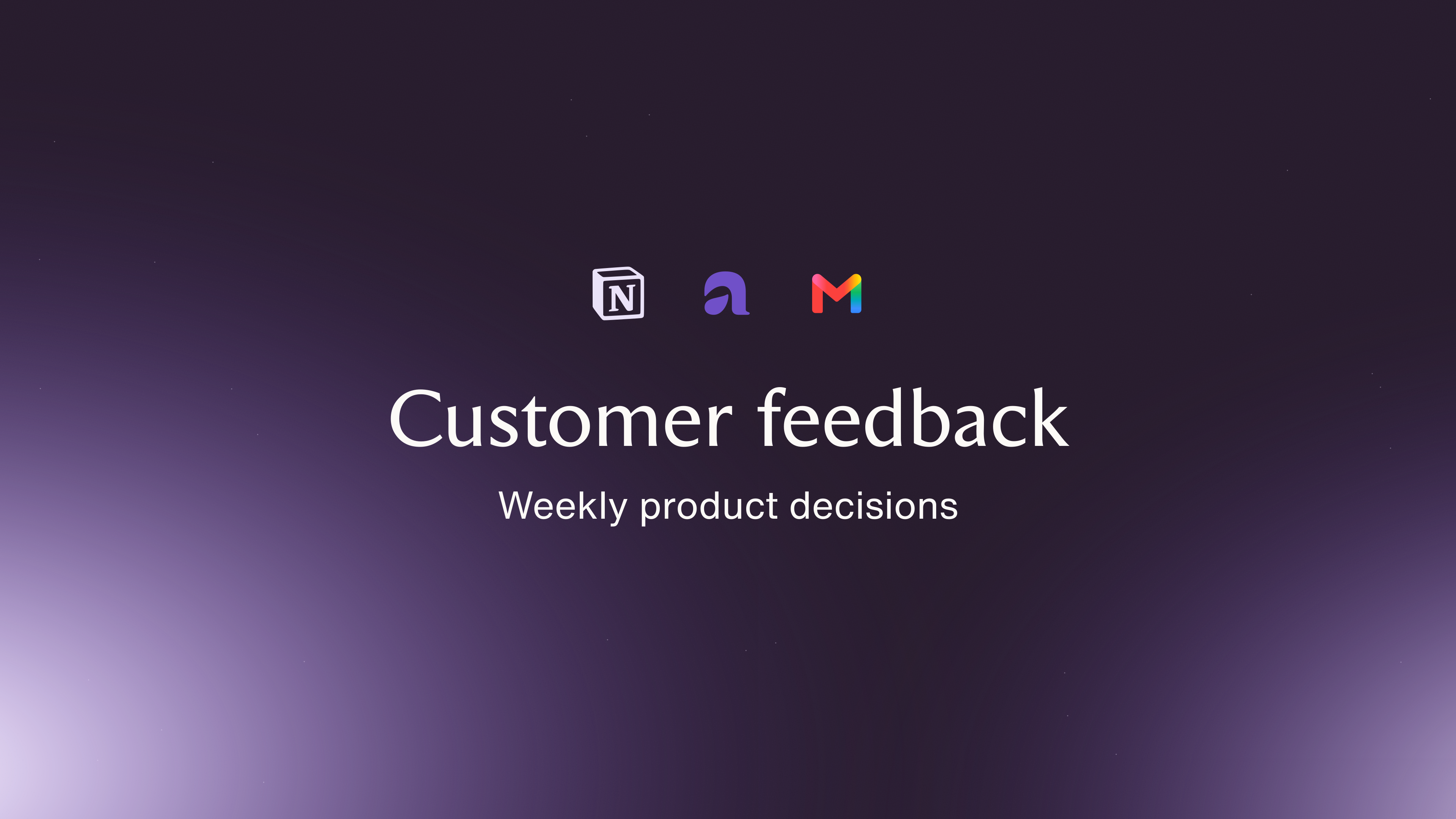
Choose Artie when your product team needs a weekly brief assembled from customer calls, support email and CRM notes. He brings the themes, affected customers and source excerpts into a Notion page, so the meeting can start with what needs attention. Dovetail, Thematic and SentiSum belong on the same shortlist when you also want a shared research workspace, a maintained theme model or continuous customer-experience monitoring.
The buying decision is how you want customer evidence to reach product. A useful brief separates a new problem from an old complaint, shows who is affected and exposes the question the team still needs to answer. This guide compares four tools on that work: the sources they bring together, the analysis behind the brief and how the findings reach the people making decisions.
Artie publishes this guide and is included in the shortlist.
Artie: a weekly brief from the feedback you already collect
A product lead should not have to reconstruct the week from account notes, support threads and meeting transcripts before every planning discussion. Artie's customer feedback workflow handles that preparation as a recurring assignment. He reads the connected sources, groups related requests and complaints, and writes the brief to the team's chosen Notion page.
The useful output is specific: top themes, what is new this week, representative excerpts and open questions for product. Each item retains the customer, date and source link. Distinct customer counts keep one person's repeated messages separate from a problem reported by several customers.
That makes Artie a strong choice for a lean team whose immediate need is a dependable product discussion. The work starts with the HubSpot notes, support inbox and call transcripts the team already uses, and ends with a brief in its working documents. You can delegate that deliverable without making a dedicated customer-intelligence repository the center of the process.
Product still sets priorities. The brief identifies what customers said, including which sources were unavailable, rather than treating a subset of conversations as a measure of the entire customer base.
As of November 11, 2026, Artie starts free, with up to $130 in onboarding credits that do not renew monthly. The Team plan starts at $100 per month for 10,000 shared credits, with no seat or AI-employee fees. Work consumes credits according to the job, so the plan is an entry commitment, not a fixed price for unlimited briefs.
What a useful Monday brief looks like
Fictional example: Larch, a small scheduling-software company, uses HubSpot notes, a shared support inbox and customer-call transcripts. Its product lead receives the following weekly brief in Notion.
New issue: appointment changes are hard to spot. Four customers reported missing a rescheduled appointment. Support threads S-18 and S-24 describe the old time remaining prominent in the confirmation email. Call C-09 includes the excerpt, “I saw the original time first and thought nothing had changed.” The open question is whether the mobile email layout hides the updated time.
Recurring request: appointments for multiple locations. Three customers asked to manage staff across locations. Account notes H-12 and H-27 describe managers switching between calendars. Call C-14 adds a different need: a receptionist must see availability across all locations. Those needs could lead to different designs.
Positive signal: the new reminder wording is clearer. Two customers said the updated reminder made the location easier to find, in support thread S-31 and call C-16. That improvement should survive any redesign of the confirmation email.
The product lead's decision is to investigate the appointment-change email this week and bring the supporting threads to engineering. Multi-location scheduling stays in discovery until the team resolves the manager-versus-receptionist question. The brief gives the meeting a concrete outcome: one investigation, one unresolved design question and one improvement to preserve.
This is the value of delegating the brief to Artie. Product receives the customer context needed to choose the next piece of work, while the underlying conversations remain available when someone challenges the interpretation.
Dovetail: recurring briefs built on a shared research workspace
Dovetail combines customer feedback with a reusable research environment. Interviews, recordings, surveys and support conversations can become evidence for questions the team asks later. Transcripts, highlights and playable clips are particularly useful when a product decision depends on hearing the qualification behind a customer's comment.
Its Agents also do the weekly work. An agent can summarize the past week's support feedback by theme with a quote for each theme, run on a schedule or event, and take actions through connected tools. Notion, Slack, Linear and Salesforce are among its external MCP connectors. AI Docs can become product briefs or reports, update as fresh evidence arrives and be delivered on a recurring schedule through Slack, Teams or email.
Dovetail therefore belongs in this decision even if the immediate output is only a Monday brief. Its additional value is the shared evidence base behind that brief: a team can return to earlier interviews, combine findings across studies and reuse the same customer context for later product questions. Its agents operate from customer evidence connected to the Dovetail workspace and can also read and act through external connectors.
As of November 11, 2026, Dovetail lists Bronze at $4,800 annually for the platform and up to five users, plus credits at $0.15 each, with Agents included. The Bronze card is marked “Coming soon.” The page also offers a 30-day Gold trial. Artie's monthly entry plan and Dovetail's listed annual platform commitment are different ways to begin, not a comparison of total cost for the same workload.
Thematic: consistent themes across a wider feedback program
Thematic fits teams that need product, support and CX to work from a common interpretation of customer feedback. It brings together sources such as surveys, support tickets, call transcripts and CRM notes, then builds themes that trace back to the underlying comments.
The theme editor lets analysts merge, split or rename themes. That matters when a broad category such as “scheduling problems” conceals separate issues with confirmations, staff availability and multi-location administration. A maintained theme model lets different teams ask questions of the same body of feedback, while business-metric analysis helps them examine which themes accompany changes in customer experience.
Thematic can also bring that analysis to the weekly meeting. Its workflows send custom dashboards and weekly digests through Slack or email, alongside alerts for changing themes and sentiment. Its MCP server makes the analysis available inside compatible AI assistants. For teams that want reporting delivered for them, its Reporting Service produces recurring reports from their Thematic data under a separate annual subscription.
Choose Thematic when the durable theme model and shared analysis are part of what you want to buy. Its role extends beyond producing one summary or leaving an analyst to distribute every update manually.
SentiSum: product insight from customer-service signals
SentiSum is a strong candidate when support conversations are central to the product team's understanding of friction. Its Insights Agent, Kyo, analyzes support data, reviews, CRM notes and surveys, answering questions about repeat contacts, changing sentiment and product issues with sample conversations and supporting metrics.
That analysis can happen in Slack. With a connected SentiSum account, a teammate can ask Kyo for last week's top issues in a channel or direct message. The Slack integration brings the question into the team's conversation, while anomaly alerts can flag unusual changes as they emerge.
SentiSum also supports scheduled email digests, including daily, weekly, monthly and quarterly delivery. The combination suits a support-led product review: the regular digest supplies the broader picture, and alerts draw attention to a developing issue between meetings. It is a credible alternative for recurring insight and action, not just a dashboard to check occasionally.
Choose the work you need every week
For a lean product team already collecting useful feedback in calls, email and its CRM, start with Artie. The assignment has a clear business result: a weekly Notion brief that brings the customer evidence into the product discussion, with an accessible monthly starting point.
Dovetail adds a shared research environment with its own recurring agents and rich source material. Thematic centers the decision on consistent themes across a broader feedback program. SentiSum brings conversation analysis, scheduled digests and emerging-issue alerts into support-led decisions. Each can deliver useful work beyond its own interface.
If the missing piece is the brief itself, give Artie the weekly customer-feedback assignment. Ask for the themes, what changed and the questions product must resolve. Make Monday's meeting about what to do with the evidence.